
Designing HMIs that support people, performance and responsibility
At APEM, product innovation is driven by a clear and shared responsibility: designing human-machine interfaces that contribute to safer, healthier and more sustainable environments, while supporting performance and ease of use in everyday operations. As a global manufacturer, APEM places people at the heart of its designs—developing solutions that enhance interaction quality, reduce physical and cognitive strain, and improve overall user experience across a wide range of professional applications.
This approach is fully aligned with the vision of the IDEC Group, which promotes a society where humans and machines work in harmony. In line with this philosophy, APEM develops interfaces that are intuitive, reliable and durable, helping users work more comfortably and confidently while enabling customers to design equipment that is efficient, robust and responsible.
Through these commitments, APEM delivers solutions that balance human needs, operational performance and environmental consideration—contributing positively to people’s daily work and to a more responsible industrial ecosystem.
Custom capacitive technology keypads support operator well-being
APEM’s custom capacitive keypads go beyond modern design: they deliver tangible CSR value by supporting safer work environments, better hygiene in healthcare, and more sustainable equipment.
Because capacitive activation is force-free, it helps reduce strain, fatigue and repetitive stress injuries, especially in high-frequency tasks such as pick-to-light operations in warehouses or two-hand safety control on machine tools. This supports operator well-being while improving efficiency and reducing errors.
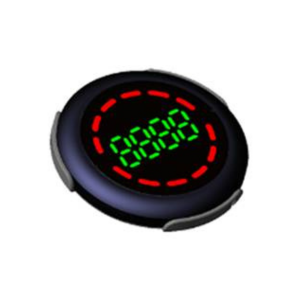
In medical applications, capacitive keypads offer a flat, fully sealed interface with no crevices, making cleaning faster and more effective. They resist aggressive disinfectants and can be engineered to avoid accidental triggering during isopropyl alcohol disinfection, helping reduce infection risks and improving patient safety in critical care environments.
Finally, capacitive technology supports eco-design: fewer mechanical parts mean lower material consumption, while an extremely long lifetime reduces maintenance needs and limits electronic waste—contributing to more responsible product design.
Dualmec Series, fully dependable for medical equipment & laboratory instruments
The APEM Dualmec Series PCB switch is designed for medical equipment interfaces, laboratory instruments, and other compact control panels where reliability is essential to protect users, patients and sensitive processes.
With IP67 sealing, the Dualmec switch resists dust and moisture, supporting dependable operation even under frequent cleaning or exposure to fluids. Its 2-pole architecture provides an added layer of redundancy, while its long lifecycle ensures stable performance over time—reducing the risk of failure in safety-critical applications.
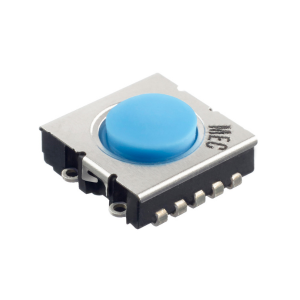
From an ergonomic perspective, Dualmec delivers crisp tactile feedback, helping users confirm actuation without hesitation. This supports error prevention and improves operator confidence during delicate actions, such as test sequences or clinical adjustments.
By minimising failures and limiting maintenance-related interruptions, Dualmec contributes to health and well-being: less downtime means greater continuity in patient care workflows and uninterrupted research and diagnostics in laboratories.
HF Series, for ophthalmic surgery bed’s control
The APEM HF joystick with Z axis is integrated into the control system of an eye surgery bed, supporting smoother and safer positioning during highly sensitive medical procedures.
To address healthcare requirements, the HF series features full redundancy on all X, Y and Z axes, ensuring continuous availability and secure motion control. This redundancy is a key contribution to risk reduction, helping prevent unexpected loss of control and supporting safe surgical conditions.
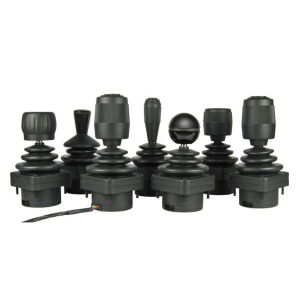
Ergonomics is also essential for medical staff: the HF joystick provides multi-axis control with simultaneous motion, enabling intuitive handling of complex movements without repeated actions or repositioning. Its high accuracy supports surgeons in performing delicate ophthalmic operations, contributing to better clinical outcomes and reinforcing APEM’s commitment to health, well-being and safer medical environments.
IV Series, panel switch with NAMUR-type contact, always reliable, even in harsh environments
The APEM IV Series panel switch is designed for demanding applications such as construction vehicles and joystick controls, where operator safety depends on reliable signal management. In these environments, electrical faults can create hazardous situations—particularly when controls are exposed to vibration, impacts, dust and harsh operating conditions.
To address this, the IV Series uses a NAMUR-type contact, a proven safety-oriented technology that helps prevent at least two critical failure modes: disconnection and short-circuit. By improving fault detection and ensuring predictable switching behaviour, this technology supports safer machine operation and contributes to risk reduction for operators and nearby workers on worksites.
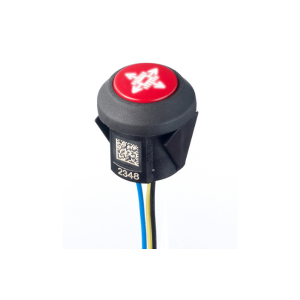
Ergonomics also plays a role in safety. The IV Series provides crisp tactile feedback, enabling blind operation with confidence and reducing incorrect inputs—especially when wearing gloves or working in low-visibility conditions. This helps limit mistakes and supports more secure handling of vehicle functions in real-world jobsite operations.
Q14 Dual Icon reduces misinterpretation in e-Transportation dashboards & industrial control panels
The APEM Q14 Dual Icon indicator supports safer operation in e-transportation dashboards, industrial control panels, and diagnostic status indication. By integrating two distinct color signals in a single 14 mm component, it enhances readability and helps operators instantly distinguish between key statuses—especially in dynamic environments where reaction time matters.
Its “secret till lit” icon technology further strengthens safety by making symbols visible only when illuminated, improving clarity in low-light conditions and reducing the risk of misinterpretation. This directly contributes to human error reduction, supporting safer decisions for vehicle operators and machine users.
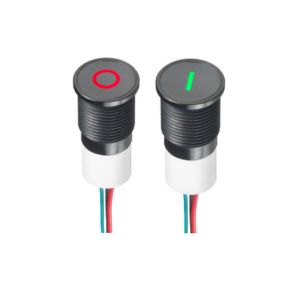
The Q14 Dual Icon also reflects eco-design in use: dual functionality in one indicator reduces the number of components required, optimises panel space, and simplifies wiring. This contributes to lower material consumption and reduced system complexity—supporting more efficient and responsible designs in modern electrified and industrial applications.
The TS Series helps save lives on the Atlantic Class 85 lifeboat
The APEM TS Series thumbstick joystick is part of the pendant control system used on the Atlantic Class 85 lifeboat, enabling remote control via a flexible cable. In a rescue context, this contributes directly to safer and more reliable manoeuvring, supporting crews in demanding and unpredictable sea conditions.
Designed for intuitive operation, the TS Series combines two-axis control with a castle actuator to improve ergonomics and precision. This reduces unnecessary effort for operators, helping limit fatigue and supporting worker well-being during long or repeated interventions.
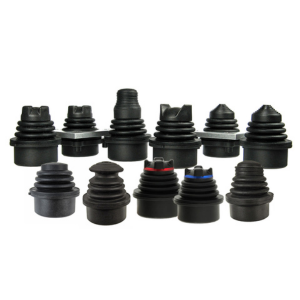
This solution has a clear social impact: the vessel is operated by the RNLI (Royal National Lifeboat Institution), a sea rescue charity. By enabling smoother control and reducing operator strain, APEM technology actively supports maritime safety and emergency response—helping rescue teams focus on what matters most: saving lives at sea.