
APEM reaches IEC 62443-4-1 Maturity Level 2
Date: 04/11/2026
Loading...
Reading time: 5 min
Content
APEM has reached an important milestone in its product cybersecurity programm: Bureau Veritas LCIE has successfully validated APEM's IEC 62443-4-1 Maturity Level 2 assessment.
The standard establishes secure product development requirements for organizations creating components and solutions used in industrial automation and control systems.
For APEM, adopting IEC 62443-4-1 creates a structured cybersecurity framework that can be applied throughout product development and maintenance, while also preparing the company and its customers for increasingly demanding cybersecurity regulations.
What is IEC 62443-4-1?
IEC 62443 is a family of international standards dedicated to cybersecurity for industrial automation and control systems. Within this framework, IEC 62443-4-1 focuses specifically on the secure product development lifecycle.
Rather than specifying only which security functions a product should contain, the standard defines how manufacturers should organize their engineering processes so that cybersecurity is considered systematically throughout a product's lifetime.

Secure development lifecycle stages:
cybersecurity requirements;
secure product architecture and design;
implementation;
security verification and validation;
vulnerability management;
product maintenance;
eventual product retirement.
With this certification, APEM makes cybersecurity a cornerstone of its product development process, with strong involvement from engineering teams and full integration from the earliest stages of every project.
What does Maturity Level 2 mean?
IEC 62443-4-1 evaluates not only whether cybersecurity activities exist but also whether they are implemented through established development processes.
Reaching Maturity Level 2 demonstrates that secure development practices are managed through defined processes rather than being dependent solely on individual projects or engineers.
For APEM, this means formalizing a common framework covering areas such as threat analysis, secure design rules, verification evidence, technical documentation and vulnerability management.
The result is a development process that is structured, reproducible and auditable.

Why APEM selected IEC 62443-4-1?
APEM and IDEC selected IEC 62443-4-1 as the foundation for their product cybersecurity development approach because it provides a recognized framework that also supports preparation for European regulatory requirements.
In particular, the methodology helps structure activities relevant to:
the Cyber Resilience Act (CRA);
the EU Machinery Regulation;
cybersecurity risk analysis;
technical documentation;
conformity assessment preparation.
From process certification to secure products
IEC 62443-4-1 primarily addresses the manufacturer's development process.
This distinction is important.
Certification of the development organisation does not automatically mean that every product is individually IEC 62443-certified. Instead, it establishes the secure development framework under which products can subsequently be designed, assessed and maintained. APEM's next cybersecurity milestone is the deployment of certified cybersecurity reference architectures across its embedded product portfolio. Designed as ready-to-use foundations for future developments, these architectures enable customers to accelerate innovation while addressing cybersecurity compliance from the very beginning of their projects, transforming compliance from a constraint into a competitive advantage.
This creates a progression from:
secure organization → secure development processes → secure product architectures → product-level compliance
For customers, this approach provides greater visibility into how cybersecurity is managed before, during and after product development.
IEC 62443-4-1 and the Cyber Resilience Act
The implementation of IEC 62443-4-1 also supports APEM's preparation for the EU Cyber Resilience Act.
The CRA introduces lifecycle cybersecurity obligations for products containing digital elements. Manufacturers will increasingly need to demonstrate that cybersecurity risks are considered not only when products are launched but also throughout the period during which they are supported.
IEC 62443-4-1 provides a structured engineering framework for many of the processes involved, including security requirements, vulnerability management, documentation and product maintenance.
APEM is consequently assessing its existing portfolio against CRA requirements while developing an evaluation framework for future product compliance.

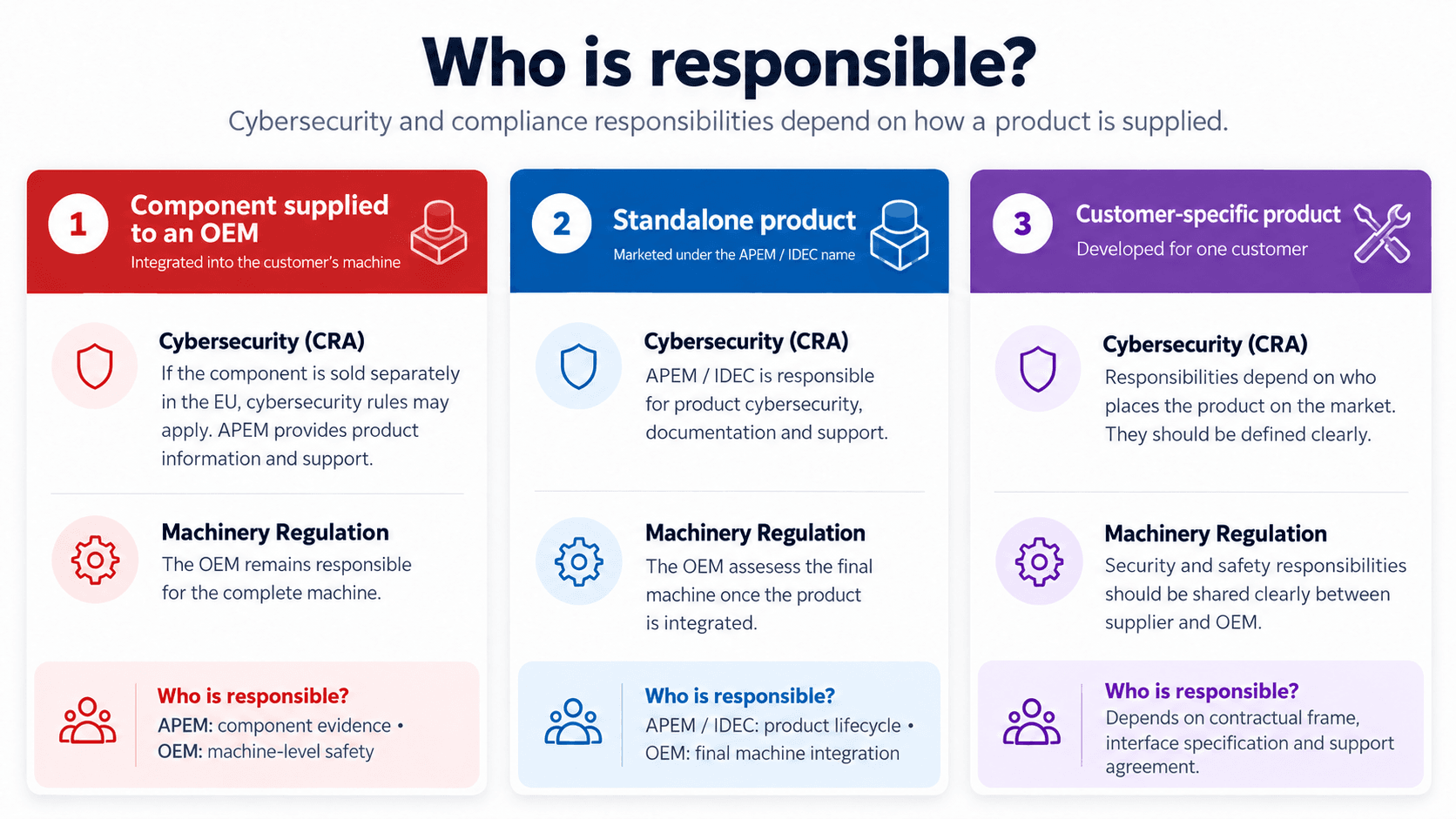
Cybersecurity, who is responsible?
Cybersecurity and compliance responsibilities vary depending on how an APEM product is supplied and integrated. Whether APEM provides a component, markets a standalone product or develops a customer-specific solution determines how responsibilities are shared between APEM and the OEM, particularly under the Cyber Resilience Act and Machinery Regulation.
PSIRT : vulnerability management after product release
Secure product development does not stop when a product leaves the factory. New vulnerabilities can be identified during operation, requiring manufacturers to evaluate their impact and determine whether corrective measures are necessary.
APEM has therefore established a Product Security Incident Response Team (PSIRT).
The team manages vulnerability reports, assesses their severity and coordinates both corrective actions and associated communication.
Building cybersecurity expertise across APEM and IDEC
IEC 62443-4-1 is also part of a broader effort to develop cybersecurity expertise within the Group.
APEM has created a Functional Safety and Cybersecurity Competence Center in France to support product teams with methodology, development and certification activities.
For OEMs and system integrators, this means that IEC 62443-4-1 is not being treated as an isolated certification exercise. It forms part of a broader programm designed to integrate cybersecurity into APEM's engineering processes, product architectures and lifecycle support.
Vulnerability and cybersecurity incident reporting form
If you identify a potential vulnerability in an APEM product, or experience a cybersecurity incident involving one of our products, please report it through this form.
Key takeaways
APEM has reached IEC 62443-4-1 Maturity Level 2.
Cybersecurity is now integrated into a structured secure product development lifecycle.
This approach supports preparation for the CRA and EU Machinery Regulation.
Next step: extend the framework toward product-level certification and lifecycle security.
Sign up to receive our newsletter, emails about special offers, updates and new releases.
Get the help and resources you need quickly with APEM
If you have questions or suggestions, we’re here to listen.
Our sales and support set the standard for helping you.
All the technical documentation you need to make things work...