
B10d: definition, calculation and applications
Date: 24/04/2026
The regulatory framework
In Europe, manufacturers must ensure compliance with the EU Machinery Regulation (EU) 2023/1230, which replaces the previous Machinery Directive and introduces stricter requirements for machine safety, including the reliability of safety-related control systems. To demonstrate compliance, manufacturers commonly rely on harmonized standards such as ISO 13849-1 and IEC 61508, which provide methodologies to design and evaluate functional safety architectures.

💡 The B10d value represents the number of cycles at which 10% of a population of components will have failed dangerously.
Our test bench for calculating the B10d value of our products.
From B10d to MTTFd: a key step in ISO 13849 compliance
The machinery safety standard ISO 13849-1 requires the determination of MTTFd (Mean Time To Dangerous Failure) for each component involved in a safety function.
MTTFd represents the average expected time until a dangerous failure occurs, expressed in years.
It is a fundamental input used to determine the Performance Level (PL) of a safety-related control system.
When dealing with components that operate in cycles (such as switches), MTTFd cannot be directly defined without considering usage. This is where B10d becomes essential.
The relationship between B10d and MTTFd depends on the mission profile, particularly:
The mean number of operations per year (nop)
The application duty cycle
From this data, engineers can convert B10d into MTTFd and integrate it into the overall safety calculation.
MTTFd = B10d / (0.1 × nop)
The MTTFd value is then used in the determination of the Performance Level (PL) of the safety function according to ISO 13849-1.
Integrating B10d into system-level safety calculations
Once converted into MTTFd, the value is integrated into:
ISO 13849 Performance Level (PL) calculations,
IEC 61508 Safety Integrity Level (SIL) evaluations: MTTFd can be converted into PFHd, which is then used in SIL evaluation.
At system level, this allows engineers to:
Quantify the probability of dangerous failure per hour (PFHd
Validate that the overall safety function meets target risk reduction levels
Optimize system architecture (redundancy, diagnostics, fault tolerance)
This approach ensures that safety is not only compliant but also robust over the full lifecycle of the machine.

How MTTFd contributes to Performance Level (PL)
In ISO 13849, overall risk reduction is achieved through a combination of:
Component reliability: MTTFd → how often dangerous failures occur
Diagnostic coverage: DCavg → how well dangerous failures are detected
and System architecture: Category → how the system tolerates faults
Component reliability (MTTFd) | Diagnostic coverage (DCavg) | System architecture (Category) | Typical achievable PL |
Low | None / Low | B or 1 | PL a – b |
Medium | Low | 1 or 2 | PL b – c |
Medium | Medium | 2 or 3 | PL c – d |
High | Medium | 3 | PL d |
High | High | 4 | PL e |
How APEM can support your functional safety requirements
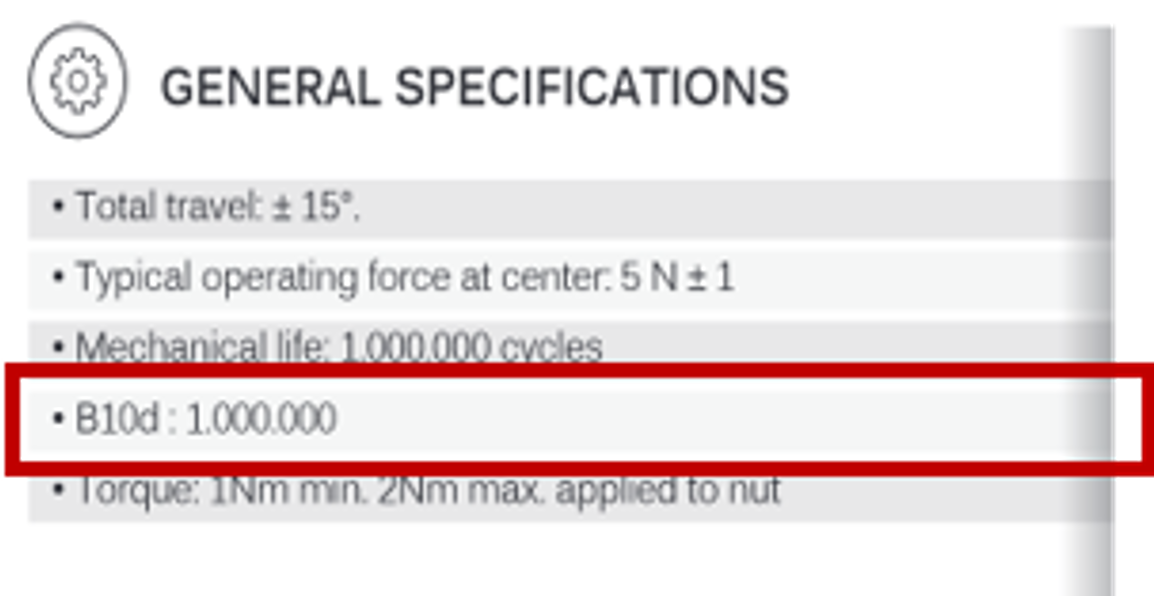
APEM supports OEMs and system designers in integrating functional safety into their applications by providing reliable and actionable B10d data, either directly indicating the B10d value of a given APEM product or by calculating it for you:
❔Questions about the functional safety compliance of our products or your systems?
👉 Contact us — we’re here to support you!
Get the help and resources you need quickly with APEM
If you have questions or suggestions, we’re here to listen.
Our sales and support set the standard for helping you.
All the technical documentation you need to make things work...