
Custom keypad glossary: Key terms and technologies explained
1. Industrial / Mechanical Design
Layout design
Definition of the keypad architecture, including key positioning, spacing, grouping, and interface zoning, to meet ergonomic, functional, and integration requirements.
Overlay design
This applies to our MEMBRANE Keypads OR TACTILE Keypads. We develop the graphical interface layer for you, including legends, symbols, color coding, transparency zones, and branding elements, with consideration for readability, durability, and environmental constraints.

For simple overlay design we commonly use silk screen printing process, the process provide accuracy.

For a blended color radiant render & high-definition overlay, we use digital printing equipment
Keycap design
This applies for our TACTILE Keypads. we can either customize a standard catalog keycap by adding a legend printing. Shall you not find in our range the keycap you want, we can even design a full custom keycap for you.
Here is our range of standard keycaps : MEC Keycaps
Here is a short video about keycaps marking : VIDEO
Layout Design
Customize the button arrangement to meet your specific needs.
Overlay Design
Create custom graphics and colors to match your brand guidelines.


Materials & finishes
This applies to our METAL Keypads. We offer a wide range of different metals such as Aluminum, Stainless Steel 304, 316L. Shall your environment require extreme resistance to salt spray, we recommend to use Stainless Steel 316L.
For aluminum-based keypads, APEM can also anodize it to give it an exclusive finish.
Mechanical fixations
Design of fastening and retention features used to integrate the keypad into the host assembly, ensuring positional stability, assembly robustness, and compliance with system-level mechanical & environmental constraints ( panel sealing to dust & water ingress)
Shielded window integration
Design and integration of a display or viewing window with shielding properties, ensuring optical clarity, EMC compatibility where required, and smooth chanical and visual continuity with the surrounding keypad surface.
2. HMI / User Interaction
Different actuation types (slider, key, wheels), latching function and long press
This mostly concern our CAPACITIVE Keypads. Capacitive technology offers more freedom to design different keypad operating modes such as slider (slide your finger up and down for example to dim the light), keys with long press or latching function to mimic a ON OFF switch…


Haptic feedback
A built-in vibration response that provides physical confirmation when a control is activated, improving user awareness and interaction confidence.
Tactile feedback
We can customize the physical feel of activation when pressing the key, giving you the exact tactile signature you need for your equipment.
Embossing
Applicable to MEMBRANE Keypads only, we can thermos shape the overlay to give the keypad keys additional tactile feeling and / or a finger guide for intuitive interaction.
Actuation force
The amount of force required to activate a key or control, defined to achieve the right balance between ease of use, precision, and accidental activation prevention.
Actuation force on a key or switch if commonly expressed in Newtons.
Backlight / dimming / NVIS
Integrated illumination features that enhance key visibility in low-light conditions, with adjustable brightness. Compatibility with Night Vision Imaging Systems (NVIS) can also be assessed.
3.Electrical / Electronic Integration
Tail pitch & connector
Flexible Membrane keypads cannot use standard harnesses. We commonly use a PCB tail on which we fit a connector. The pitch between the tracks can be customized


Special connector
For keypads relying on rigid PCB we can use either PCB connectors or any type of connectors commonly used on wires. Tells us the brand and model you need, let us handle the rest.
Integration of panel components (Estops, key switches.)
Some customers need combination of keypads + standard panels switch such as toggle switches, security caps, emergency stops, keylock switches…. Unlike push buttons, toggle switch and selector switches have the benefit to indicate visually to the user whether the switch is activated or not. Being a switch manufacturer, APEM can integrate any of our panel switches into your custom keypad.
4. Communication / System Interface
APEM can offer various communication protocols*, such as :
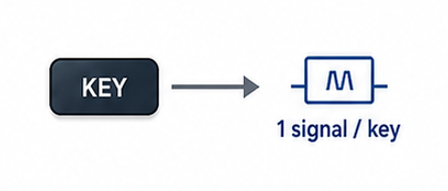
Discrete
Simple individual signal outputs, where each key press provides its own direct electrical output for straightforward system interfacing.
-> Flexible membrane keypads are only available with discrete output.
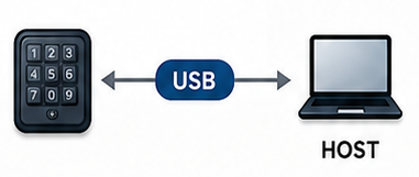
USB
A standardized digital interface that enables easy connection of the keypad to host equipment for data communication and power through a single cable.
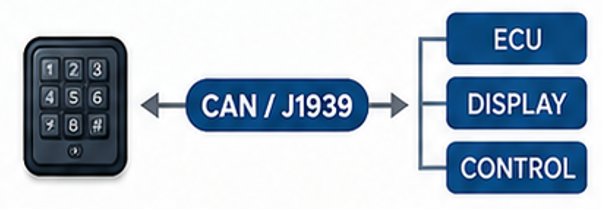
CAN J1939
A CAN-based communication solution using the SAE J1939 protocol, suited to vehicle and industrial systems that require standardized data exchange and network integration.
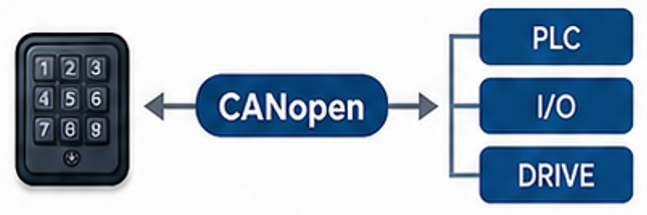
CANopen
A higher-layer CAN protocol that allows the keypad to communicate efficiently with controllers and other devices in industrial automation networks.
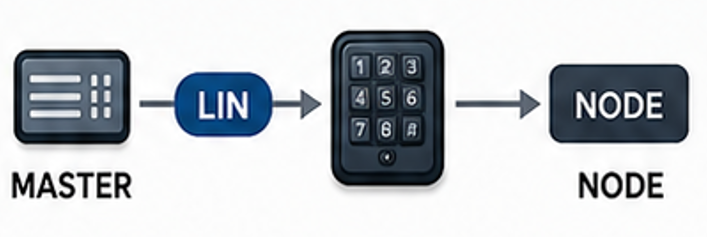
LIN Bus
A cost-effective serial network interface designed for simple distributed controls, ideal for applications where lower speed and simpler wiring are preferred.
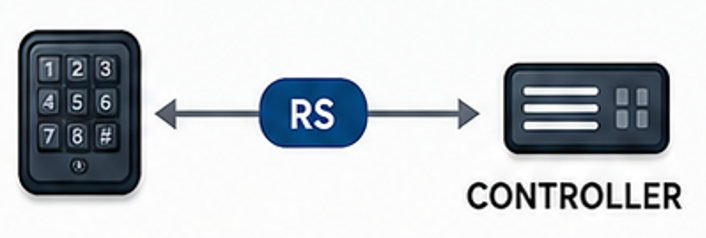
RS Serial (RS-232 / RS-423)
A serial communication interface for direct point-to-point data exchange with control equipment, often used in legacy, industrial, or dedicated device connections.
❗Flexible membrane keypad limitation
Flexible membrane keypads are only available with discrete output.
5. Advanced Functional Integration
Integration of Fingerprint ID Sensor
Add a Fingerprint ID sensor to your keypad for secure biometric access.
Integration of RFID Reader
Incorporate an RFID reader for contactless card or tag access.

6. Environmental / Durability Requirements
Chemical resistance requirement will be first assessed by our engineering team, material of the front panel will be chosen in consequence Design keypads that resist exposure to harsh chemicals and cleaning agents.
