
What is a NAMUR feature and why is it used?
Date: 31/03/2026
What is a NAMUR feature?
A NAMUR feature follows recommendations defined by NAMUR (originally short for Normenausschuss für Mess- und Regelungstechnik, now known as the User Association of Automation Technology in Process Industries).
Instead of switching voltage like a normal contact, the device changes the current flowing through the circuit. The connected electronics measure this current and interpret the condition of the device and its wiring. The device therefore becomes a diagnostic signal source rather than a simple switch.
How does it work when integrated into a switch?
A NAMUR contact device does not switch voltage like a conventional contact. Instead, the control electronics supply a small constant voltage and continuously measure the current flowing in the circuit (the loop current). The sensor behaves like a controlled electrical load: when its state changes, the amount of current it draws changes. By reading this current value, the input module can determine both the position of the device and the condition of the wiring.
Current level | Meaning |
Higher current | Normal state |
Lower current | Activated |
0 mA | Broken wire |
Excessive current | Short circuit |

2 resistors are placed in series and in parallel with the switch
Why this is important?
Unlike a standard contact that only provides two states (open or closed), the NAMUR interface provides multiple detectable electrical conditions. This allows the system to distinguish between a valid command and an electrical failure.
For example:
If the button is pressed → the system detects a legitimate state change
If the cable breaks → the system detects a fault, not a command
If wires touch → the system detects an abnormal condition

The signal therefore carries two pieces of information at the same time:
The command (activated or not)
The electrical integrity of the circuit
Because the current is very low, the measurement remains stable over long cables and in harsh environments, making the information more reliable than a simple switching contact.
Why not use a conventional pushbutton?
A standard pushbutton only changes the mechanical contact position. The control system assumes the wiring is correct. A NAMUR pushbutton confirms that the wiring is correct. Although a NAMUR switch looks like a regular button, the way it operates is fundamentally different, more sophisticated, and intrinsically safe.
It is a relevant alternative to the use of dual contact switches such as NO/NC contacts that can enable diagnostics of the mechanical and electrical states thanks to the second contact but which need more wires within the system, whereas we are dealing with confined and limited environments, or is suitable to upgrade existing systems which already have existing harnesses that cannot be easily modified.
To better understand this difference, please refer to the comparison below:
What we compare | Regular Pushbutton | NAMUR Pushbutton |
Main job | Turns things on or off (like starting a motor or turning on a light) | Activates an active signal for both ON and OFF states, enabling diagnostics of invalid signals that can occur due to abnormal failure modes concerning the component |
How it works | Simply opens or closes a wire connection | Connects a resistance network through the switch contact |
Electricity used | Can carry enough electricity to power devices | Uses a limited level of current (signal range), which automatically limits the arcing effects. |
What signal it sends | Simple “on” or “off” active contact | “Normal active states” = a range of active/current/voltage depending on polarization |
Can it notice broken wires? | No, if a wire breaks, it can lead to an active state ON or OFF depending on the switch cabling. | Yes! If a wire breaks (current = 0), the system detects it right away |
What happens if something goes wrong? | May not allow detection of an abnormal condition of switch use. | The system is intrinsically safe via the diagnostic capability enabling the system to actuate a “safe mode” (prevents danger) |
What are the benefits for industrial safety?
Combining protection against explosion, dependable diagnostics, and compliance with functional safety standards, NAMUR buttons provide a safety protection system with many benefits such as:
Providing safe signal transmission by preventing sparks or ignition sources, so it is used for safety-critical functions rather than normal on/off control.
Minimizing risks, protecting personnel and assets, and ensuring continuous, trustworthy performance in high-stakes industrial settings.
Enabling early detection of wiring faults (open circuit, short circuit, cable breakage)
Supporting fail-safe operation — the system automatically moves to a safe state if a problem occurs
Essential for compliance with ATEX, IECEx, and functional safety standards (e.g. SIL-rated systems)
In which fields are NAMUR switches most commonly used?

The operation of heavy machinery requires controls that enhance safety. Design engineers will always try to ensure the safety of the operators and their environment using reliable components with predictable behavior. However, if an equipment function fails, it is vital that it fails in a safe condition.
Most switches rely on a physical mechanism to function. However robust and reliable a switch may be, shock and vibration can create intermittent loose electrical connections, and worn wires can create short circuits, which can be difficult or even impossible to detect for a given system set-up. Below are some of the main industries that commonly apply NAMUR buttons:
Construction: NAMUR buttons are now widely used in heavy construction machinery and related equipment to enhance safety on rough, dusty, or potentially hazardous construction sites. Similarly, they are applied in material handling equipment (cranes, forklifts, conveyor systems, stackers, etc.) used at construction sites, ports, or warehouses, especially in areas with flammable dust or combustible materials.
Forestry Machinery: Utilized in harvesters, transporters, timber tractors, and tree cutters, the inherent safety design, with no sparks, eliminates ignition risk from hydraulic systems or chainsaws (especially in dusty, wood-dust environments), while ensuring reliable signal transmission to support functional safety under high-risk conditions.
Agricultural Machinery: Integrated into tractors, combine harvesters, sprayers, and forage harvesting equipment in dusty fields or areas near flammable crop residues and fuels.
Mining Equipment: Essential for underground loaders, drilling rigs, transport trucks, and continuous mining equipment in areas with high methane content or dusty conditions. NAMUR buttons eliminate ignition risk, combined with reliable fault detection and signal transmission to maintain functional safety and prevent unsafe conditions.
Material handling machinery: Applied in cranes, forklifts, conveyor systems, stackers, and long-range forklifts in warehouses, ports, or industrial areas with a risk of flammable dust. They ensure interlocking and safety monitoring (e.g. overload protection, door status), providing consistent, reliable signals to support functional safety systems.
Discover the series of NAMUR buttons from APEM
NAMUR button – IV series
To leverage the NAMUR push buttons in industrial safety, APEM has created the IV series that uses the technology employed by NAMUR sensors. Designed for use in hazardous atmospheres, these sensors work by changing their electrical characteristics depending on the proximity of their target. To create a switch for safety-critical applications, the APEM switch uses the same electrical circuit with resistors that are wired in parallel and in series.
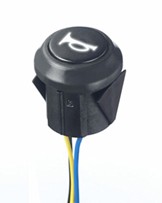
The key feature of this technique is that the electrical circuit is always completed. A short circuit would bypass the switch and its associated resistor, changing the input. The switch communicates with a control unit which will detect this change and determine that the switch is not functioning correctly.
In this way, the control unit can detect dangerous failures such as short circuits and disconnections, and determine whether the switch is functioning correctly. Construction equipment can be highly dangerous if not operated properly.
It is vital to ensure that if a machine fails, it does so in a safe mode. Switches which use NAMUR architecture provide constant feedback on the safe operation of their circuit.
NAMUR button – IX series
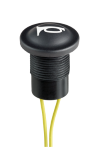
The IX NAMUR is a waterproof pushbutton specifically designed for hazardous environments, where both mechanical durability and electrical reliability are critical. Unlike traditional pushbuttons that simply open or close a circuit, the IX NAMUR is capable of communicating the state of the circuit itself, combining three essential functions in a single compact component: environmental protection, mechanical durability, and electrical diagnostics.
Its robust design ensures reliable operation under mechanical stress, vibration, and challenging conditions. The pushbutton provides operators with strong tactile feedback and a smooth elastomer actuation that confirms activation, even when wearing gloves or operating machinery in motion.
With front panel sealing up to IP67/IP69K and a customizable design, the IX NAMUR delivers both safety and usability in one advanced pushbutton solution.
Have any questions about NAMUR switches?
If you are designing safety-critical equipment or upgrading an existing control architecture, our experts can help you select the right NAMUR pushbutton for your application. Whether you need technical guidance, compliance clarification (ATEX, IECEx, SIL) or integration support, the APEM team is ready to assist.
Get the help and resources you need quickly with APEM
If you have questions or suggestions, we’re here to listen.
Our sales and support set the standard for helping you.
All the technical documentation you need to make things work...